Previously Looked-After Children (PLAC)
Section outline
-
Supporting the Education of Previously Looked-After Children in Early Years Settings
Since September 2018, Virtual Schools have had a statutory duty to provide advice, guidance and information to schools, parents and a range of professionals, working to improve the educational outcomes of previously looked-after children. The Virtual School promotes a culture of high aspirations, progress and achievements for all our vulnerable children and young people. However, the Virtual School is not the corporate parent for PLAC, so does not case hold these children.
PLAC Status
For a child to be classified as PLAC, they must have been under the care of a local authority for one day or more before moving to a new order of permanence.
- A child’s new order of permanence (adoption, special guardianship order, *or child arrangement order*) will state within the first few pages that, prior to the order being granted, the child was in the care of a named local authority. This indicates that they were a child in care/looked after prior to the new order of permanence
- not all children with a special guardianship or child arrangement order will have been ‘looked after’ by a local authority and may not be classified as PLAC. If the order of permanence does not clearly state that the child has previously been in care, schools can contact the relevant post-adoption or post-SGO team to request this information. Adoption UK suggest that schools can request a letter from the local authority where the child was looked after immediately prior to their order of permanence.
- if a child returns to their birth parents after a period of being looked after/in care, this is categorised as reunification. This is not a new order of permanence, so PLAC status will not apply
- the DfE states that schools should be ‘satisfied’ of PLAC status in order to record this information on the autumn term school census and receive pupil premium plus funding (PP+)
Key Aims
- Make visible the needs of care-experienced children and raise awareness of attachment-aware and trauma-informed practice
- promote relational practice that ensures positive educational experiences and achievement for PLAC
- enhance partnerships between parents/carers, education settings and other relevant professionals
-
As a social care professional, you play an important role in helping early years settings understand and meet the needs of previously looked-after children (PLAC). The information below outlines how the Virtual School can support professionals, families and settings to improve educational outcomes and promote wellbeing.
Working with the Virtual School
The Virtual School provides advice, guidance and consultation to professionals working with previously looked-after children, as well as parents, carers and early years settings. We can support discussions around the needs of individual children, transition planning, attachment-aware practice and strategies to promote positive educational outcomes.
If you would like advice regarding a child you are working with, or support for a setting, please contact us at vsextendedduties@hants.gov.uk . Please ensure that parental consent has been obtained before sharing information about an individual child.
Early Years Pupil Premium (EYPP)
Previously looked-after children aged 3 and 4 are eligible for EYPP, which provides additional funding to early years settings to support learning, development and school readiness.
Social care professionals can help by:
- ensuring parents and carers are aware of EYPP eligibility
- encouraging families to discuss their child's status with the early years provider so that funding can be claimed
- supporting settings to consider how EYPP can be used effectively to meet the child's individual needs
- promoting review and evaluation of the impact of any interventions funded through EYPP
Emotional Wellbeing, Safeguarding and Inclusion
Many previously looked-after children may have experienced adversity, loss, disrupted attachments or early trauma. Professionals should support early years settings to understand how these experiences can affect a child's behaviour, emotional regulation, relationships and learning.
Key considerations include:
- promoting trauma-informed and attachment-aware practice
- supporting the development of secure and trusting relationships
- ensuring consistency of care, routines and expectations
- recognising and responding to individual social, emotional and developmental needs
Partnership Working with Parents and Guardians
Strong partnership working between professionals, families and early years providers is essential. Adoptive parents, special guardians and carers hold valuable knowledge about a child's experiences, strengths and needs.
Professionals should encourage:
- open communication between families and settings
- sensitive sharing of information where appropriate and with consent
- joint planning to support the child's development, wellbeing and transitions
Training and Professional Development
Although training on attachment and trauma is not a statutory requirement, it is strongly recommended for staff working with previously looked-after children.
The Virtual School offers a range of free training opportunities covering:
- attachment-aware practice.
- trauma-informed approaches.
- understanding the needs of previously looked-after children
- strategies to improve educational and emotional outcomes
Further information can be found via the Hampshire Virtual School training offer: Course: Training Offer | Hampshire Virtual School
Post-Adoption Support
Post-adoption support must be requested directly by parents or carers. Professionals can play an important role in increasing awareness of available support and encouraging families to access services when needed.
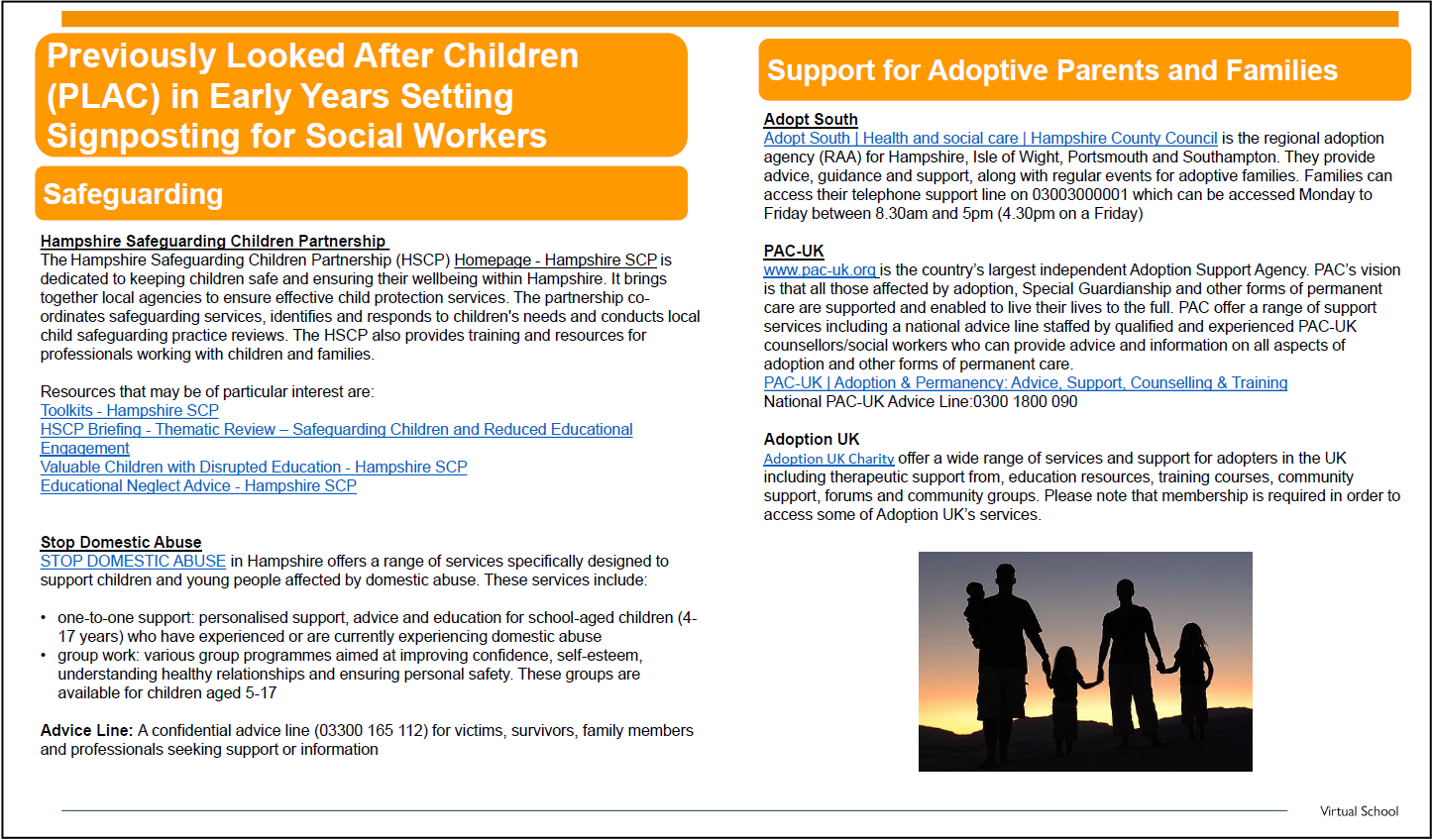
Adopt South provides advice, guidance and therapeutic support to adoptive families. More information is available at: www.hants.gov.uk/socialcareandhealth/adoptsouth
Families can also access the Adopt South support line on 0300 3000 001, Monday to Thursday, 8.30am to 5.00pm and Friday, 8.30am to 4.30pm.
Post-SGO Support
Support for children subject to a special guardianship order (SGO) can be accessed through Hampshire's Family Connections Service. Support must usually be requested by the special guardian, so settings should encourage families to seek support where needed.
The service can provide advice, guidance and access to specialist support to help children and families thrive. Further information is available on the Hampshire County Council website:
-
Pupil Premium Plus Funding – From Year R
Pupil premium plus (PP+) is additional funding provided to schools to help support the education of children who are previously looked after. This funding is designed to help close the attainment gap and ensure that previously looked-after children have the best possible opportunities to succeed in school. The decision on use of PP+ spending sits with the school and it must be focused on education. However, the views of parents/carers should be considered.
Once a school is ‘satisfied’ with the child’s status and they qualify as PLAC, they can amend their school census record. Ultimately, the headteacher takes responsibility for the school census, registers and DfE returns. PLAC status must be recorded on the school's autumn (October) census in order to receive PP+ funding for the following financial year. Each child recorded as PLAC on the autumn census currently generates £2690 (2026-2027).Further information on PP+ is available via the resources links at the top of this page.
Early Years Pupil Premium Funding – Preschools/Nurseries/Childminders
The early years pupil premium (EYPP) aims to support early years settings in narrowing the achievement gap between children from certain potentially vulnerable groups, including previously looked-after children, and their peers. Its purpose is to enhance the progress of these children in education through focused and strategic interventions and support, encouraging practitioners to give particular attention to their development.
Previously looked-after children (PLAC), including those who left care through adoption, a special guardianship order (SGO) or a child arrangements order (CAO), are entitled to early years pupil premium (EYPP) if they are accessing government-funded early education. In England, PLAC children are eligible for EYPP at ages 3 and 4, and adopted children aged 2 may also qualify for a funded early education place.Further information on EYPP is available via the resources links at the top of this page.
Early Years Funded Hours - Preschools/Nurseries/Childminders
Early years funded hours are government-funded hours for children to attend EYs education (preschools, nurseries or childminders) before they begin formal schooling. Depending on the age and circumstances of the child, different amounts of hours are available via government funding.
Previously looked-after children (PLAC) are entitled to the same universal and extended early education entitlements as other children, but they may also benefit from additional eligibility routes and funding support:- all 3- and 4-year-olds, including PLAC children, are entitled to 15 hours per week of universal funded early education for 38 weeks of the year
- eligible 3- and 4-year-olds may receive an additional 15 hours per week (30 hours in total) if they meet the working parent eligibility criteria
- children aged 2 who have been adopted from care are entitled to a funded early education place, regardless of family income, through the disadvantaged 2-year-old entitlement.
Term time hours are calculated on the child attending for 38 weeks per year.
Further information on early years funded hours is available via the resources links at the top of this page.