Children in Kinship Care
Section outline
-
Children in Kinship Care in Early Years Settings – Key Information for Parents and Carers
In September 2024, the role of Virtual Schools expanded further to specifically include championing the educational attendance, attainment and progress of children in kinship care.
What Can I Expect from my Child's Early Years Setting?
- a positive partnership that supports you and your child in all aspects of their early development, learning, wellbeing and readiness for the next stage of their education
- regular communication about your child's strengths, interests, progress and any areas where they may need additional support. Whilst it is NOT a statutory requirement, a personalised plan, such as an education support plan (ESP), created collaboratively between school and home, is valuable
- opportunities for your child's voice, preferences and interests to be recognised and reflected in their learning experiences
- early identification and timely support for any emerging developmental, learning, communication, social or emotional needs
- collaboration with relevant professionals, services and organisations to ensure your child receives the right support at the right time
- a welcoming, inclusive environment where your child feels safe, valued and able to thrive
- relevant training and support provided for staff
Previously Looked-After Child (PLAC) Status
Children in kinship care can also be a previously looked-after child (PLAC). For a pupil to be PLAC, they will have been in local authority care, and immediately moved to a new order of permanency through:
- adoption
- special guardianship order (SGO)
- residency order (RO) ceased 2014
- child arrangement order (CAO)
If a child is previously looked after, they can receive pupil premium plus funding (PP+), and funding can be applied for from the adoption and special guardianship support fund (ASGSF). For more information on both of these, please go to the early years PLAC section of our Moodle.
-
The Virtual School is working to:
- develop early years settings understanding of different kinds of kinship care arrangements
- support early years settings to understand the importance of greater focus and visibility for the distinct needs of kinship children and families
- promote relational practice that ensures positive educational experiences and achievement for children in kinship care
- understand the role of the early years setting in identifying and supporting their kinship care families
- offer training and development to early years settings and partners
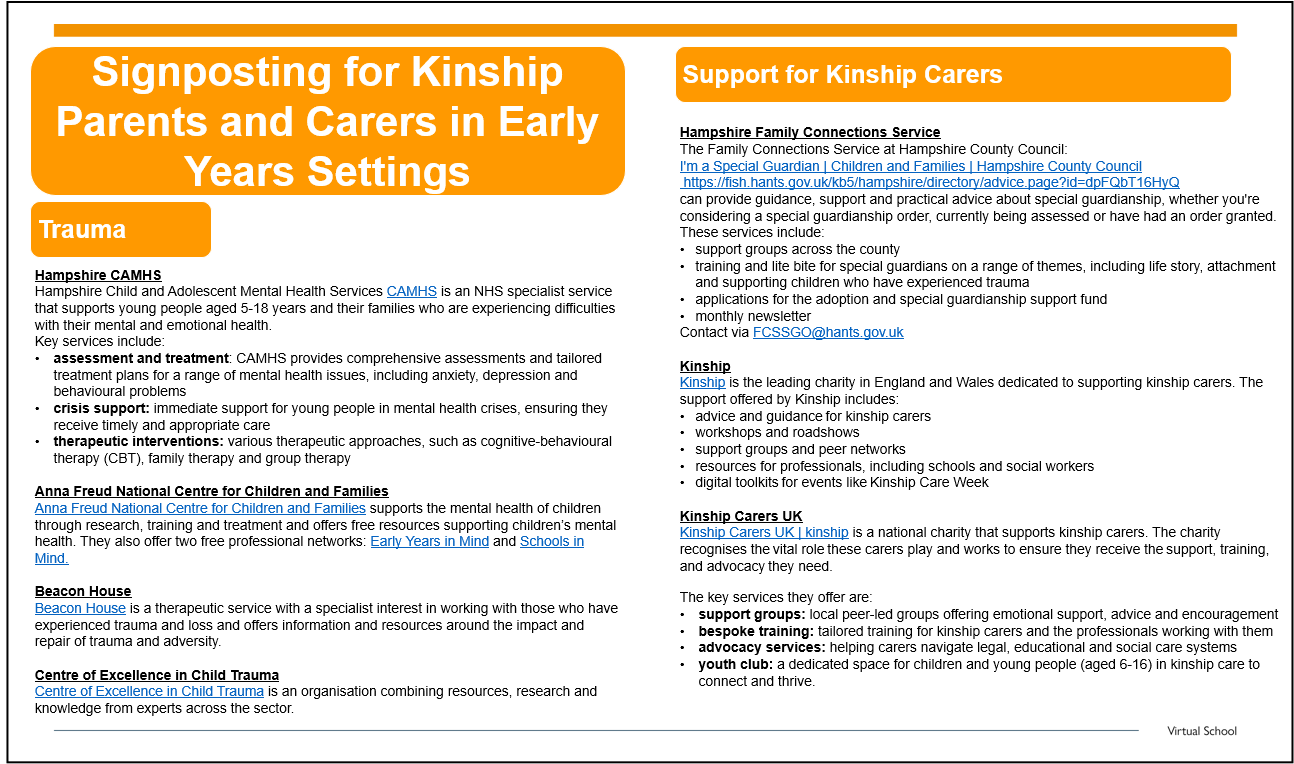
- signpost to support and resources currently available to kinship care families
- provide advice and guidance to all kinship carers with special guardianship orders and child arrangement orders, regardless of whether their child was previously looked-after by the local authority
-
Pupil Premium Plus Funding – From Reception Year
Pupil premium plus (PP+) is additional funding provided to schools to help support the education of children who are previously looked after. Children in kinship care may receive PP+ if they are also a previously looked-after child. (For more information, please look at our early years PLAC section.) This funding is designed to help close the attainment gap and ensure that previously looked-after children have the best possible opportunities to succeed in school. The decision on the use of PP+ spending sits with the school and it must be focused on education. However, the views of parents/carers should be considered.
Once a school is ‘satisfied’ with the child’s status and they qualify as PLAC, they can amend their school census record. Ultimately, the headteacher takes responsibility for the school census, registers and DfE returns. PLAC status must be recorded on the school's autumn (October) census in order to receive pupil premium plus (PP+) funding for the following financial year. Each child recorded as PLAC on the autumn census currently generates £2690 (2026-2027).Early Years Pupil Premium Funding – Preschools/Nurseries/Childminders
The early years pupil premium (EYPP) aims to support early years settings in narrowing the achievement gap between children from potentially vulnerable groups, including previously looked-after children living under adoption orders (AO), child arrangements orders CAO) or special guardianship orders (SGO), and their peers. Its purpose is to enhance children's progress through focused and strategic interventions and support, encouraging practitioners to give particular attention to their development.Children aged 3 and 4 who are previously looked after and in kinship care arrangements under a special guardianship order (SGO) or child arrangements order (CAO) may be eligible for EYPP. Settings should work with parents and guardians to identify eligible children and claim the funding. Please see our Early Years PLAC section for further information.
Early Years Funded Hours – Preschools/Nurseries/Childminders
Early years funded hours are government-funded hours for children to attend early years education (preschools, nurseries or childminders) before they begin formal schooling. Depending on the child's age and family circumstances, different amounts of funded childcare are available.Children in kinship care are not automatically entitled to additional funded hours because of their legal status. However, they may be eligible through the disadvantaged 2-year-old offer, if they have an education, health and care plan (EHCP), receive Disability Living Allowance, or meet other eligibility criteria. All children are entitled to the universal 15 hours of funded early education from the term after their third birthday, with some families eligible for up to 30 hours through the working parent entitlement.
- All 3- and 4-year-olds, including children in kinship care, are entitled to 15 hours per week of universal funded early education for 38 weeks of the year
- eligible 3- and 4-year-olds may receive an additional 15 hours per week (30 hours in total) if they meet the working parent eligibility criteria
- children aged 2 who have been adopted from care are entitled to a funded early education place, regardless of family income, through the disadvantaged 2-year-old entitlement
Term time hours are calculated on the child attending for 38 weeks per year.