Previously Looked-After Children (PLAC)
Section outline
-
Previously Looked-After Children in Early Years Settings – Key Information for Parents and Carers
The Virtual School has a statutory duty to provide advice and guidance to parents, carers, education settings and other professionals to promote and improve the educational experiences and outcomes of previously looked-after children (PLAC). Hampshire Virtual School provides this service for the families and associated professionals of children attending Hampshire early years settings, even if the child does not live within the county. If you live in Hampshire but your child attends an early years setting in a different local authority, then you should contact the Virtual School in the area that your child is being educated.
Previously Looked-After Child (PLAC) Status
For a child to be classified as PLAC, they must have been under the care of a local authority for one day or more before moving to a new order of permanence through adoption, a special guardianship order (SGO), care arrangement order (CAO) or a residency order (RO, issued up until 2014).
What Can I Expect from my Child's Early Years Setting?- ensure collaboration between key staff (designated teacher/designated lead, key person, DSL, SENDCO, safeguarding governor/committee member/manager)
- understand individual needs and barriers to learning, using available needs analysis tools
- prioritise PLAC in planning, interventions and support
- regular communication about the strengths and the needs of your child. Whilst it is NOT a statutory requirement, a personalised plan, such as an education support plan (ESP), created collaboratively between school and home, is valuable
- build strong relationships with the child, ensuring child voice is at the centre of any decisions made
- utilise pupil premium plus (Year R) or early years pupil premium (preschool/nursery) to effectively support the PLAC in education, narrowing the disadvantage gap
- provide relevant training and support for staff
-
Pupil Premium Plus Funding – From Year R
Pupil premium plus (PP+) is additional funding provided to schools to help support the education of children who are previously looked after (PLAC). This funding is designed to help close the attainment gap and ensure that previously looked-after children have the best possible opportunities to succeed in school. The decision on use of PP+ spending sits with the school and it must be focused on education. However, the views of parents/carers should be considered.
Once a school is ‘satisfied’ with the child’s status and they qualify as PLAC, they can amend their school census record. Ultimately, the headteacher takes responsibility for the school census, registers and Department for Education (DfE) returns. PLAC status must be recorded on the school's autumn (October) census in order to receive pupil premium plus (PP+) funding for the following financial year. Each child recorded as PLAC on the autumn census currently generates £2690 (2026-2027).Further information on pupil premium plus is available via the resources links at the top of this page.
Early Years Pupil Premium Funding – Preschools/Nurseries/Childminders
The early years pupil premium (EYPP) aims to support early years settings in narrowing the achievement gap between children from certain potentially vulnerable groups, including previously looked-after children, and their peers. Its purpose is to enhance the progress of these children in education through focused and strategic interventions and support, encouraging practitioners to give particular attention to their development.
Previously looked-after children (PLAC), including those who left care through adoption, a special guardianship order (SGO) or a child arrangements order (CAO), are entitled to early years pupil premium (EYPP) if they are accessing government-funded early education. In England, PLAC children are eligible for EYPP at ages 3 and 4, and adopted children aged 2 may also qualify for a funded early education place.Further information on early years pupil premium is available via the resources links at the top of this page.
Early Years Funded Hours - Preschools/Nurseries/Childminders
Early Years funded hours are government-funded hours for children to attend early years education (preschools, nurseries or childminders) before they begin formal schooling. Depending on the age and circumstances of the child, different amounts of hours are available via government funding.
Previously looked-after children (PLAC) are entitled to the same universal and extended early education entitlements as other children, but they may also benefit from additional eligibility routes and funding support:- all 3- and 4-year-olds, including PLAC children, are entitled to 15 hours per week of universal funded early education for 38 weeks of the year
- eligible 3- and 4-year-olds may receive an additional 15 hours per week (30 hours in total) if they meet the working parent eligibility criteria
- children aged 2 who have been adopted from care are entitled to a funded early education place, regardless of family income, through the disadvantaged 2-year-old entitlement
Term time hours are calculated on the child attending for 38 weeks per year.
Further information on early years funded hours is available via the resources links at the top of this page.
-
The Virtual School is working to:
- provide advice, guidance to parents, carers, schools and other professionals
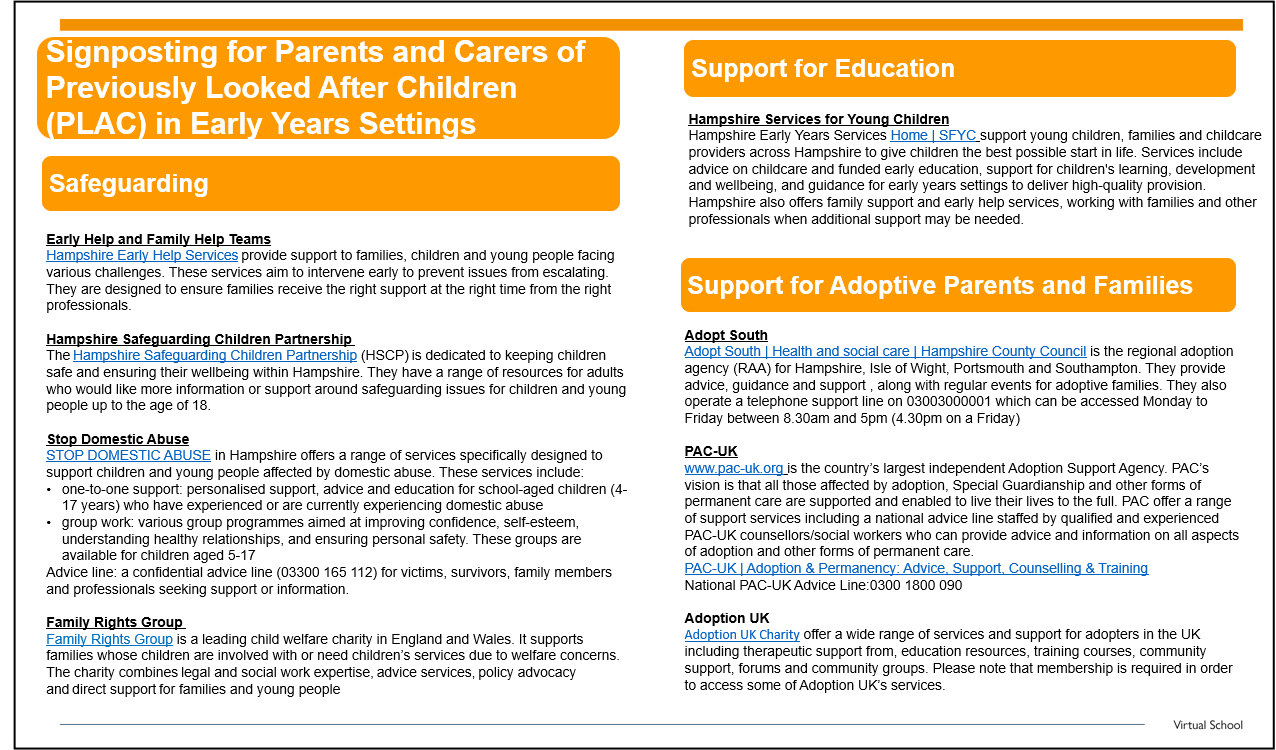
- signpost to other services, resources and support available for the families of PLAC
- provide training early years settings to develop understanding of the distinct needs of previously looked after children and advocate attachment aware and trauma informed practice
- promote relational practice that ensures positive educational experiences and achievement for PLAC
- enhance partnerships between parents/ carers, education settings, Children's Services Practitioners, family practitioners and other professionals as appropriate
The Virtual School does not work with individual children who have PLAC status - including tracking and monitoring educational progress of individual children and providing academic or other interventions.