Previously Looked-After Children (PLAC)
Section outline
-
Supporting the Education of Previously Looked-After Children
Since September 2018, Virtual Schools have had a statutory duty to provide advice, guidance and information to education settings, parents and a range of professionals, working to improve the educational outcomes of previously looked-after children and young people. The Virtual School promotes a culture of high aspirations, progress and achievements for all our vulnerable children and young people. However, the Virtual School is not the corporate parent for PLAC, so does not case hold these young people.
Key aims
-
make visible the needs of care-experienced and previously looked-after young people and raise awareness of attachment-aware, trauma-informed and relational practice
-
promote approaches that support positive educational experiences, engagement, wellbeing, progress and achievement
-
promote high aspirations and progression into higher education, employment and future careers
-
enhance partnerships between young people, parents/carers, education providers and relevant professionals
PLAC status
For a young person to be classified as PLAC, they must have been under the care of a local authority for one day or more before moving to a new order of permanence.-
a young person’s new order of permanence (adoption, special guardianship order* or child arrangement order*) will state within the first few pages that, prior to the order being granted, the child was in the care of a named local authority. This confirms that they were previously looked after
-
*not all young people with a special guardianship or child arrangement order will have been ‘looked after’ by a local authority and may not be classified as PLAC. Evidence of previous care status should be available through the relevant legal order or supporting documentation
-
if a young person returns to their birth parents after a period of being looked after, this is categorised as ‘going home’ (previously known as reunification). This is not a new order of permanence and so PLAC status does not apply
-
unlike schools, post-16 providers do not record PLAC status through the school census and do not receive pupil premium plus funding for PLAC learners. However, understanding whether a learner is previously looked-after can help providers consider appropriate support, remove barriers to participation and promote positive educational outcomes
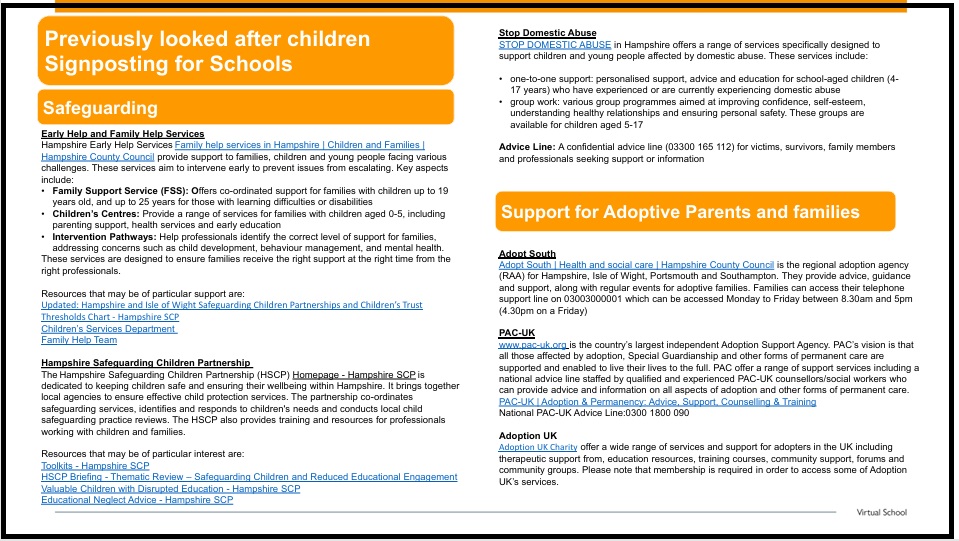
Click here to access important resources, including:
- Virtual School Guide to PEPs, Statutory Duties and More
- Education Support Plans
- Strengths and Difficulties Questionnaire (SDQs)
- Reach to Teach App
- Supporting Learning
- Training Offer
- A Relational Approach and Attachment Research Community (ARC)
- STAARS (formerly known as ATAS)
- Education Psychologists Consultations
- Attendance, Suspensions and Exclusions
- Admissions
- Governors
-